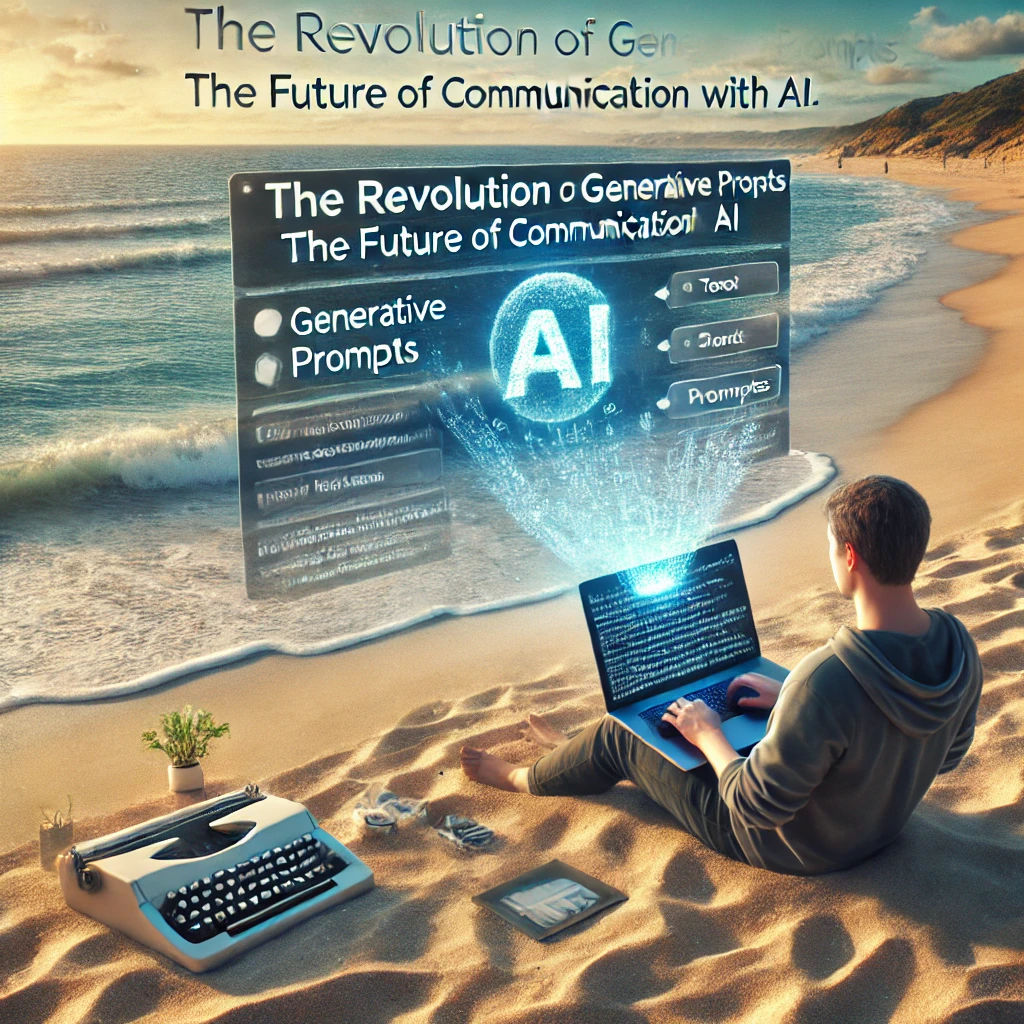
artificial intelligence (IA) has advanced rapidly in recent years, But one of the most exciting and transformative developments is the rise of generative prompts. These interactions, that allow users to guide and control the responses of AI models, They are redefining the way we communicate with technology. From content creation to complex problem solving, Generative prompts are becoming an essential tool to improve interaction between humans and machines. In this article, We'll explore how these prompts are revolutionizing AI communication and how they could shape the future of technology..
Section 1: What are Generative Prompts?
Generative prompts are instructions or questions that users provide to an AI model to generate responses or content based on those prompts.. Unlike traditional AI approaches, where interactions are limited to predefined responses, Generative prompts allow for greater flexibility and creativity, since AI can generate more complex and adaptive responses.
For example, in the field of natural language processing (NLP), models like GPT (Generative Pre-trained Transformer) They allow users to type a prompt and receive detailed responses that can range from writing articles to creating code or simulating conversations.. This has opened up a range of possibilities in various industries., from content creation to education and customer service.
Section 2: Benefits of Generative Prompts
Generative prompts offer a series of key benefits that are transforming communication with AI. Some of the most notable are:
-
Creativity without limits: Generative prompts allow users explore new ideas and solutions that were previously difficult to reach. By using AI to generate content, fresh perspectives and innovative approaches can be discovered in fields such as design, writing and marketing.
-
Personalization: With generative prompts, users can customize AI responses according to your specific needs. This is especially useful in areas such as customer service., where the answers can be adapted to the particularities of each query, improving user experience.
-
Increased productivity: The ability to automatically generate content from prompts allows companies save time and resources. From writing emails to creating reports, Generative prompts can automate repetitive tasks and free up time for more strategic activities.
-
Natural and fluid interaction: Generative prompts allow more natural communication with AIs, making interactions more intuitive and accessible for users of all skill levels. This facilitates the adoption of the technology in various applications.
Section 3: Challenges and Limitations of Generative Prompts
Despite its benefits, Generative prompts also present a series of challenges and limitations that must be addressed to ensure their effective use:
-
Ambiguity in results: Depending on how a prompt is written, AI can generate responses that do not completely meet user expectations. Clarity in the formulation of prompts is crucial for accurate and useful results.
-
Response biases: As with other forms of AI, generative prompts can reproduce biases present in training data. This can lead to the generation of content that reinforces stereotypes or presents inaccurate information..
-
Technology dependence: As organizations and individuals rely more on generative prompts, There is a risk of lose critical skills in decision making and problem solving. Overreliance on AI can limit the ability to think independently and creatively.
-
Privacy and safety: Generative prompts often require large amounts of data to work effectively, which raises concerns about the privacy and information security. Companies must be careful in managing this data to avoid possible breaches and ensure user trust..
Section 4: Innovative Use Cases of Generative Prompts
Generative prompts are already being adopted in a wide range of innovative applications. Next, There are some outstanding examples:
-
Copywriting y marketing: Companies like Copy.ai y Jarvis are using generative prompts to automate content creation advertising and marketing, from slogans to social media posts, allowing brands to produce engaging content more efficiently.
-
Customer service: Companies like Zendesk have integrated generative AI into their support systems, allowing agents to offer faster and more personalized responses to customer queries through specific prompts.
-
Education: Platforms like Khan Academy are exploring the use of generative prompts to create personalized educational experiences, where students can interact with AI that provides them with explanations and exercises tailored to their level of understanding.
-
Software development: Tools like GitHub Copilot use generative prompts to assist developers in writing code, suggesting code snippets and solutions to technical problems in real time.
Conclusion
The revolution of generative prompts marks a milestone in the evolution of communication with AI. By enabling more flexible interactions, creative and personalized, These prompts are empowering users to explore new ways to use technology in their lives and businesses.. However, to make the most of your potential, it is essential to address the ethical and technical challenges associated with its implementation.